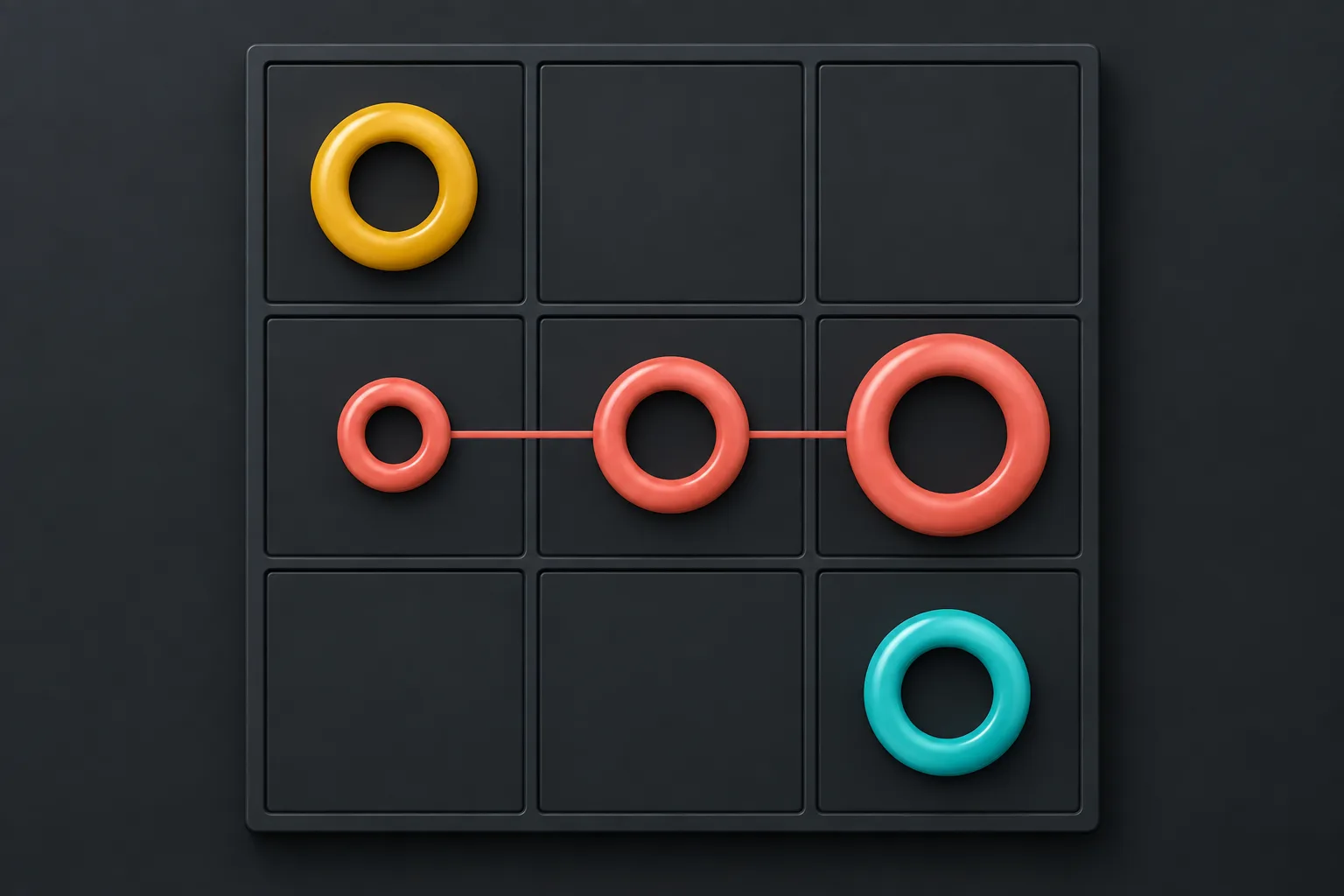
Ringzzle has eight possible lines: three rows, three columns, and two diagonals. A line clears when each of its three cells contains the same color. Ring size does not have to match.
A mixed-size example
Imagine a small coral ring in the left cell, a medium coral ring in the middle, and a large coral ring in the right. Those three rings complete a coral row.
If the middle cell also contains a yellow small ring, that yellow ring stays. A line removes the matching-color rings in its three cells, not every ring in those cells.
Read a cell as several possibilities
A cell may contain up to three colors, one in each size slot. Look through the whole cell when scanning for a line: a small ring can connect to the color of a large ring elsewhere.
If one cell contains two rings of the matched color, both are removed by the line clear. A brief matched-color indicator marks the line in the game.
Check diagonals and intersections
Corners can contribute to a diagonal as well as a row and column. Before dropping a ring, check whether that move can finish two lines at once.
Multiple lines can clear on the same move. A ring shared by two matched lines disappears once; each completed line contributes to the clear score.
A line is different from a Color Burst
A line connects three separate cells. A Color Burst starts with three sizes of one color inside a single cell and removes that color across the entire board.
When a hoped-for match does not clear, check that the color appears in all three cells of one straight row, column, or diagonal. Two neighboring cells alone are not enough.
Try a color line in Ringzzle, or review the full rules.